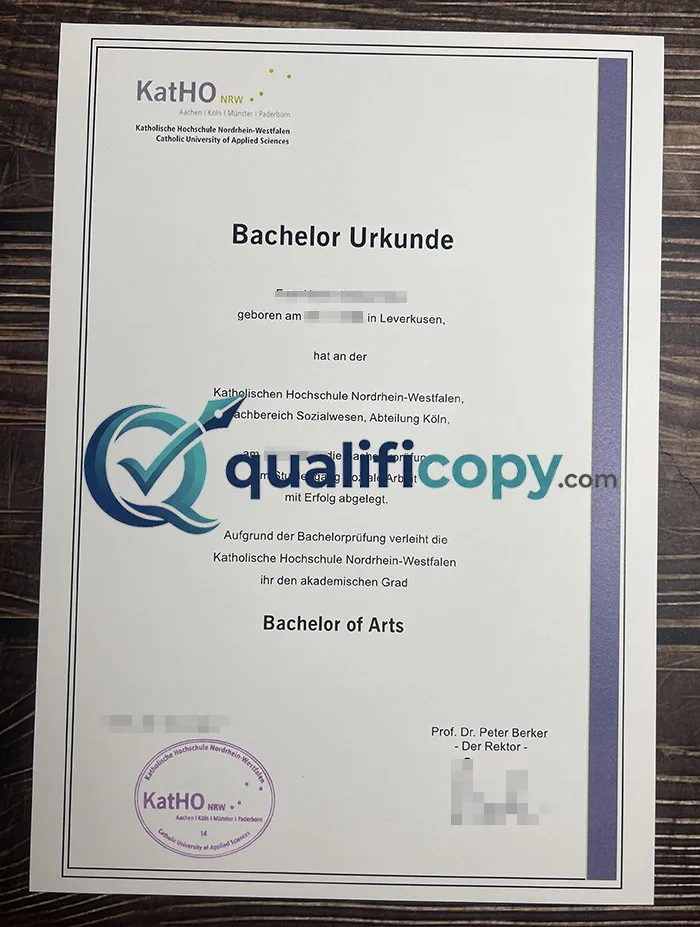
The Catholic University of Applied Sciences North Rhine-Westphalia (Katholische Hochschule Nordrhein-Westfalen, or katho) occupies a distinctive position within Germany‘s higher education landscape. KatHO NRW Urkunde, KatHO NRW degree, KatHO NRW diploma. As the country’s largest state-recognized, church-sponsored university of applied sciences, katho specializes in social work, health sciences, and practical theology, operating across four campuses in Aachen, Cologne, Münster, and Paderborn. Founded in 1971, the institution has grown from a consolidation of fifteen Catholic professional schools into a modern university of applied sciences with over 5,000 students, more than 100 professors, and a substantial research profile focused on applied social and health research. This article examines katho‘s institutional identity, academic offerings, research activities, and its evolving role within the North Rhine-Westphalian and broader German higher education system.
katho‘s origins trace back to the early twentieth century, when Catholic professional schools for social work were established by educated women seeking informed responses to the social dislocations caused by industrialization. Replica KatHO NRW Urkunde online, Novelty KatHO NRW degree online. The institution in its present form was founded in 1971 by the five Catholic dioceses of North Rhine-Westphalia—Aachen, Cologne, Münster, Paderborn, and Essen—as the Catholic University of Applied Sciences North Rhine-Westphalia (Katholische Fachhochschule Nordrhein-Westfalen, KFH NW). It was part of the first wave of Fachhochschule foundations in Germany, consolidating fifteen separate training institutions into a single coordinated entity. The founding rector was Professor Dr. Teresa Bock, a social scientist who led the institution until 1977.
The university underwent significant expansion over subsequent decades. The Department of Health Sciences was established at the Cologne campus, offering continuing education programs in nursing management and nursing pedagogy. The first Bachelor‘s degree programs were introduced in the 2000s, including Social Work, Education and Upbringing in Childhood, Special Needs Education, Nursing Science, and Religious Pedagogy. In 2008, the institution adopted its current name, changing from KFH NW to Katholische Hochschule Nordrhein-Westfalen (katho NRW). By the winter semester of 2013/2014, enrollment had reached 4,423 students, supported by 105 full-time equivalent professorships and approximately 28 positions for academic staff. Current enrollment exceeds 5,000 students across the four campuses.
How to Quickly Replace a KatHO NRW Urkunde Online?
katho operates four campuses of approximately equal size in Aachen, Cologne, Münster, and Paderborn, with the university administration and central services located in Cologne. This regional dispersion is a deliberate institutional strategy. The university‘s stated purpose in maintaining a four-campus structure is to support the presence of Catholic higher education throughout North Rhine-Westphalia and to maintain close contact with local environments and social institutions, ensuring that academic programs reflect the specific needs of each region.
Each campus has developed its own distinctive profile within the broader katho framework. The Best Way to KatHO NRW Urkunde Online. The Cologne campus hosts both the Department of Social Work and the Department of Health Sciences, as well as the university leadership and central administration. The Paderborn campus is home to the Department of Theology in addition to its Department of Social Work. The Aachen and Münster campuses focus primarily on social work and related fields. The Department of Social Work is represented at all four locations.
The Catholic University of Applied Sciences North Rhine-Westphalia represents a distinctive model of higher education that combines confessional identity with public accountability, regional embeddedness with disciplinary specialization, and academic rigor with practical orientation. From its origins in the consolidation of Catholic professional schools, katho has evolved into Germany‘s largest church-sponsored university of applied sciences, serving over 5,000 students across four campuses with a focused mission in social work, health sciences, and practical theology. Its emphasis on applied research addressing social problems and its commitment to preparing students for professional practice in social and health services position it as an integral component of North Rhine-Westphalia’s higher education infrastructure. The university‘s ongoing development of diversity strategies and its maintenance of a decentralized campus structure reflect its engagement with contemporary social challenges and its commitment to regional accessibility. As German higher education continues to evolve, katho’s model of a state-recognized, church-sponsored university of applied sciences with a strong applied research orientation offers a distinctive contribution to the landscape of academic education and social innovation.